Concept
In the field of insurance, a “master policy” refers to an insurance contract that provides unified coverage for an insured’s properties or liabilities in different locations. This type of policy is commonly used for large groups or organizations, such as schools, businesses, and institutions. For example, a “master policy” for international students is a comprehensive insurance plan designed to cover various needs, including medical insurance and personal accident insurance.
On the other hand, an “insurance certificate” is a document issued by an insurance company to certify that an insurance contract is in place. It generally does not include the full terms of the insurance policy. Insurance certificates are often used to provide proof of insurance coverage for individuals who are parts of a group covered by a master policy.
A typical example is marine cargo product that shipping companies will issue a master policy with insurer at each beginning of year while each shipping trip will be considered as different certificate.
Overall Structure
Generally speaking, master policies and their certificates or even a single policy can share the same product code and DD structure. It’s up to front-end application that determines which one to adopt as required.
- Master Policy
The most important thing is to set up the correct Policy Type at policy level.
- Certificate Policy
Apart from the policy type, the Certificate needs to be associated with the Master Policy through two fields, Master Policy ID and Master Policy No.
Master & Certificate Interaction
Master policies usually need you to enter a series of constraint rules to limit certificate behavior (such as cargo type, transportation method and port), settlement method, total premium and rate etc.
Usually, these constraint rules can be defined by using Policy Schedule models, and be loaded and checked during certificate issuance.
Typical scenario for certificate to use master policy information:
- On the UI, reading the master policy information allows you to enter content outside the agreement policy.
- During underwriting, the restriction content defined in the master policy is consumed through Rule. If there is a violation of the rules, the system will trigger underwriting rather than a direct refusal.
- When calculating the premium, see rate factors, discounts and other information defined on the master policy.
- Perform corresponding payment processing according to the settlement method specified in the master policy.
Settlement Method
In the master policy, the following settlement methods can usually be specified:
| ID | Master | Certificate |
|---|---|---|
| 1 | Direct | Direct |
| 2 | Deduction | Direct/Deduction |
| 3 | Declaration | Direct/Declaration |
| 4 | PrePay Account | PrePay Account |
-
Certificate Premium Settlement (Direct):
This method is equivalent to a single policy. When the Certificate issued, it generates its own ARAP data that is posted to BCP, which has nothing to do with the master insurance policy.
-
Regular Settlement of Premiums (Declaration):
When a Certificate is issued, it generates a fee that is not immediately posted to BCP. The master policy needs to create a settlement endorsement, select corresponding certificates and generate the current payment plan data, and then post to BCP when the endorsement is issued.
-
Deduction of Premiums from Master Policy (Deduction):
- The premium is paid in advance when the Master Policy is issued, and the total premium amount is recorded on the policy. You can also increase or decrease premiums through endorsement.
- Certificates will deduct the premium from the master policy when a policy/endorsement is issued. Each deduction of the master policy needs to generate an endorsement record.
- Before a certificate is issued, the balance of the master policy needs to be locked in advance.
- Record the SumInsured and premium balance of the master policy in table T_PA_PUB_MP_BALANCE.
- Record the corresponding transaction details in table T_PA_PUB_MP_BALANCE_TX.
-
Deduction of Premiums from Master Policy (PrePay Account):
- When the Master Policy is issued, collect the prepaid premium (MpPrePayPremium) and suspense it in BCP under the master-policy dimension. In this mode the MpPrePayPremium field must be entered, while DuePremium and other premium fields must remain 0.
- Before a certificate can be issued, the master-policy premium balance must be locked; if the certificate premium exceeds the remaining balance the system will raise an error.
- When a certificate is issued, its due premium is deducted from the master-policy balance and every deduction is recorded in BCP.
- Each certificate uses its own SumInsured field; after issuance the system deducts this amount from the master-policy MpSumInsuredLimit and updates the remaining limit (SumInsuredBalance) in table T_PA_PUB_MP_BALANCE.
- The values entered on the master policy—MpPrePayPremium and MpSumInsuredLimit—never change on the master policy itself; only the balance-table records are updated.
- Record the SumInsured and premium balance of the master policy in table T_PA_PUB_MP_BALANCE; the PA page can display the current balances in real time by calling the CoreMasterPolicyRestful service.
- Record the corresponding transaction details in table T_PA_PUB_MP_BALANCE_TX.
API Introduction
The majority of the master policy API follows the standard proposal and endorsement API.
There are some key fields that need to be passed for master policies and separate APIs are needed if there’s special settlement handing processes.
Policy Type
It’s important to setup different policy types for master policies, certificates and even single policies. The key fields in place are in the policy level:
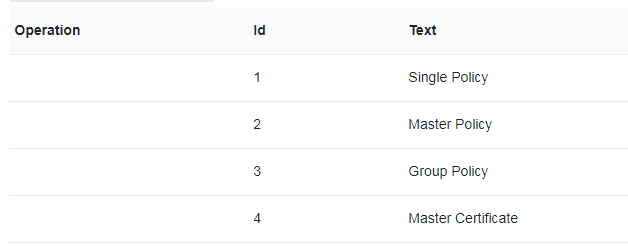
- “PolicyType”: “4”
The code value of Policy Type refers to the following data table.
Master & Certificate Relation
It’s important to setup a relationship between the certificate and its master policy when creating a certificate. The key fields in place are all in the policy level:
- “MasterPolicyId”: “9935380013,EEECC5B8941E3B94D9C24D17DA449C80”
- “MasterPolicyNo”: “POCGHP00001935”
Settlement Handling
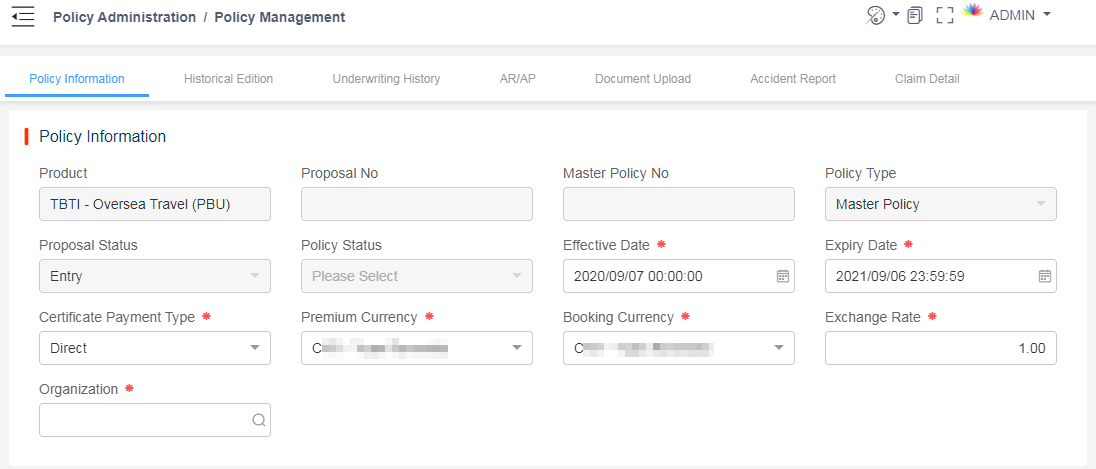
Direct Settlement (Direct):
When a master policy selects direct settlement, it only signs the agreement without ARAP.
Certificates can only be used for direct settlement, and each Certificate manages its own ARAP.
In this case, all the APIs are the same as those of Single Policies.
Declaration
When the master policy chooses declaration settlement, there is no ARAP on it.
Certificate settlement can be either direct or declaration. If direct is chosen, then each Certificate manages their own ARAP. If declaration is chosen, then it generates a Fee data when the certificate is issued. After a period (for example one month), a Settlement Endorsement is created on the Master Policy. The certificates that need to be settled are selected on the page, and ARAP is sent when the endorsement is issued.
Add an API to get all unsettled Fees generated by NB or Endorsement on this master policy.
- /pa/mp/v1/loadUnSettlementCertificate
- Calling time: in the process of Settlement Endorsement.
- Function: After the endorsement is issued, the Settlement Endorsement Item (dynamic model) can be obtained from the Endorsement object to display the endorsement certificate.
Master Policy Deduction Settlement (Deduction):
When Master Policy selects deduction, it will pay all the premiums when the policy is issued, and there will be ARAP interaction.
Certificate settlement can be either direct or deduction. If direct is chosen, each certificate manages its own ARAP. If deduction is chosen, ARAP will not be posted when the certificate is issued.
This way of issuing certificate will call below APIs:
Version 25.03
-
POST /pa/core/master/policy/v1/createInitMasterPolicyBalance
-
Trigger timing: After master calculation and before bound stage
-
Function: Set the total premium & SI on the Master Policy in advance to prevent insufficient premium deduction when the certificate is issued
-
URL:
{{server}}/api/platform/pa/core/master/policy/v1/createInitMasterPolicyBalance?masterPolicyId={{mPolicyId}}&initPremiumBalance=500&initSumInsuredBalance=50000
-
-
POST /pa/core/master/policy/v1/adjustMasterPolicyBalance
- Function: Adjust the total premium & SI on master when endorsement, to adjust master policy balance
- URL: Endorsement
{{server}}/api/platform/pa/core/master/policy/v1/adjustMasterPolicyBalance?masterPolicyId={{mPpolicyId}}&masterPolicyEndoId={{mEndoId}}&premiumDelta=100&sumInsuredDelta=10000
-
GET /pa/core/master/policy/v1/getMasterPolicyBalance -URL:
{{server}}/api/platform/pa/core/master/policy/v1//pa/core/master/policy/v1/getMasterPolicyBalance?masterPolicyId={{mPpolicyId}} -
POST /pa/core/master/policy/v1/freezeBalanceForCertificate - Trigger timing: After certificate calculation and before bound stage - Function: to freeze premium & SI for certificate from master when the certificate is issued - URL: NB
{{server}}/api/platform/pa/core/master/policy/v1/freezeBalanceForCertificate?masterPolicyId={{mPolicyId}}&certificatePolicyId={{cPolicyId}}&freezePremium=100&freezeSumInsured=10000- URL: Endorsement{{server}}/api/platform/pa/core/master/policy/v1/freezeBalanceForCertificate?masterPolicyId={{mPolicyId}}&certificatePolicyId={{cPolicyId}}&certificateEndoId={{cEndoId}}&freezePremium=100&freezeSumInsured=10000 -
POST /pa/core/master/policy/v1/deductBalanceForCertificate
- Trigger timing: certificate issue
- Function: Calling deductBalanceForCertificate API and deducting the premium for the current certificate from the Master Policy
- URL: NB
{{server}}/api/platform/pa/core/master/policy/v1/deductBalanceForCertificate?masterPolicyId={{mPolicyId}}&certificatePolicyId={{cPolicyId}}&premiumToDeduct=100&sumInsuredToDeduct=10000&requireFreezeFirst=Y - URL: Endorsement
{{server}}/api/platform/pa/core/master/policy/v1/deductBalanceForCertificate?masterPolicyId={{mPolicyId}}&certificatePolicyId={{cPolicyId}}&certificateEndoId={{cEndoId}}&premiumToDeduct=100&sumInsuredToDeduct=10000&requireFreezeFirst=Y
-
GET /pa/core/master/policy/v1/getLastBalanceTransactionForCertificate
- URL: NB
{{server}}/api/platform/pa/core/master/policy/v1/getLastBalanceTransactionForCertificate?masterPolicyId={{mPpolicyId}}&certificatePolicyId={{cPolicyId}} - URL: Endorsement
{{server}}/api/platform/pa/core/master/policy/v1/getLastBalanceTransactionForCertificate?masterPolicyId={{mPpolicyId}}&certificatePolicyId={{cPolicyId}}&certificateEndoId={{cEndoId}}
- URL: NB
Before 25.03
- /pa/mp/v1/freezeBalanceForNb(/pa/mp/v1freezeBalanceForEndo)
- Trigger timing: After calculation and before bound stage
- Function: Freezing the premium on the Master Policy in advance to prevent insufficient premium deduction when the certificate is issued
- /endo/core/endo/v1/submitEndorsement
- Trigger timing: certificate issue
- Function: Calling MasterPolicyPremiumDeduction endorsement API and deducting the premium for the current certificate from the Master Policy
Master Policy Deduction Settlement (PrePay Account):
The atomic API mirrors the Master Policy Deduction Settlement (Deduction) flow; the only variances are the tenant-specific rating logic and the customized data-passing logic to BCP.
Master Policy Version
When calculating the premium, certificates needs to read the policy version data at the corresponding point in time. This can avoid different results in subsequent recalculation of premiums. In other places (such as rule verification), it shall always get the latest master policy data.
Rating and Rule Configuration (Sample Travel Product)
For rating and rule, there is no difference from Single Policy. See the following rating nodes:
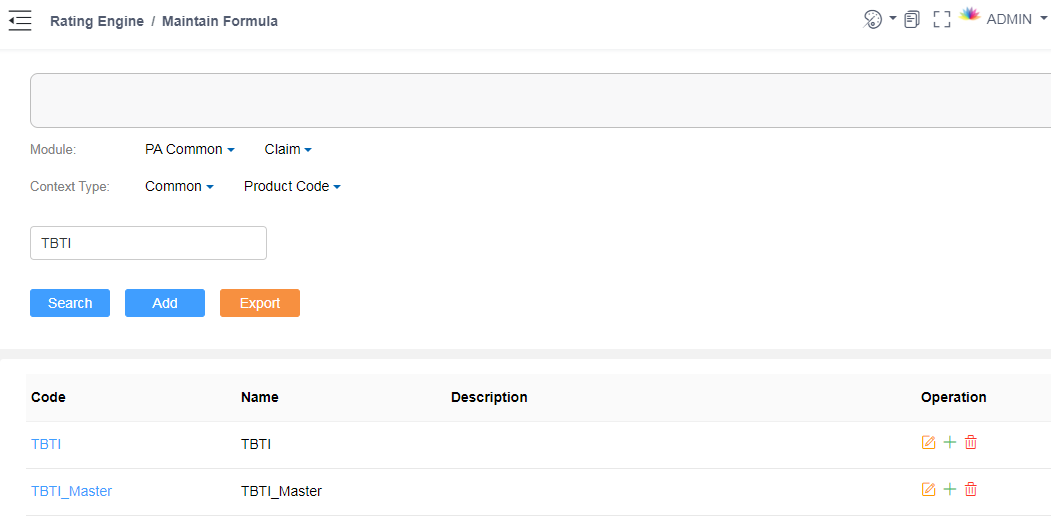
- TBTI(Certificate)
- TBTI_Master
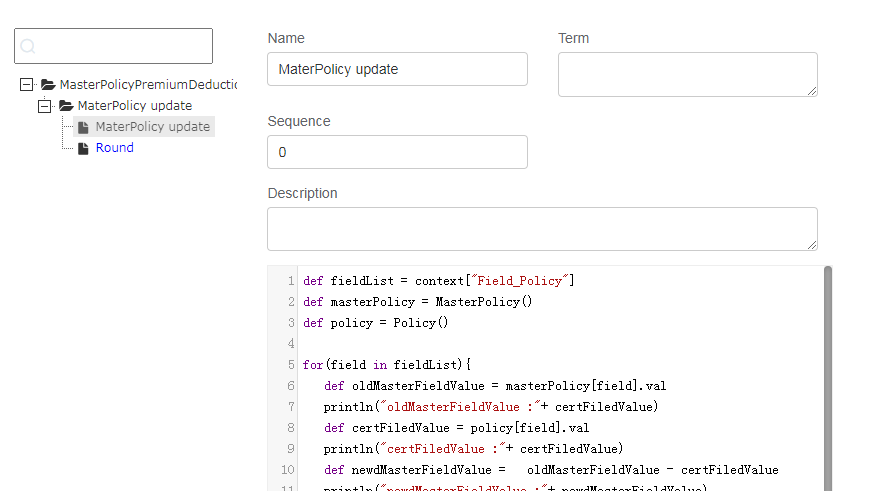
- MasterPolicyPremiumDeduction(Deduction)
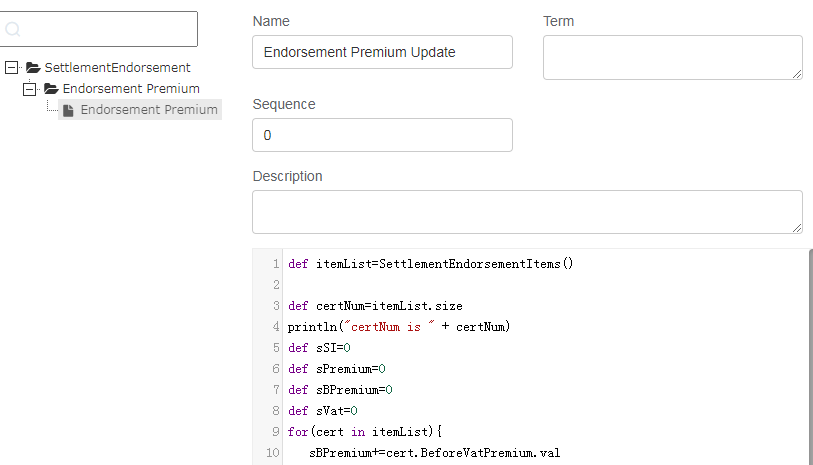
- SettlementEndorsement(Declaration)