Core Architecture
As an API orchestration tool under the InsureMO ecosystem, the core architecture can be summarized as follows:
- Adopt a two-layer invocation architecture (platform layer + tenant layer) to balance the reuse of platform capabilities and the customization of tenant businesses.
- The platform layer serves as the capability base, providing pre-configured SDKs and static methods to ensure the stability of underlying technologies.
- The tenant layer enables on-demand configuration of RESTful APIs and internal service functions to meet different business needs of different customers.
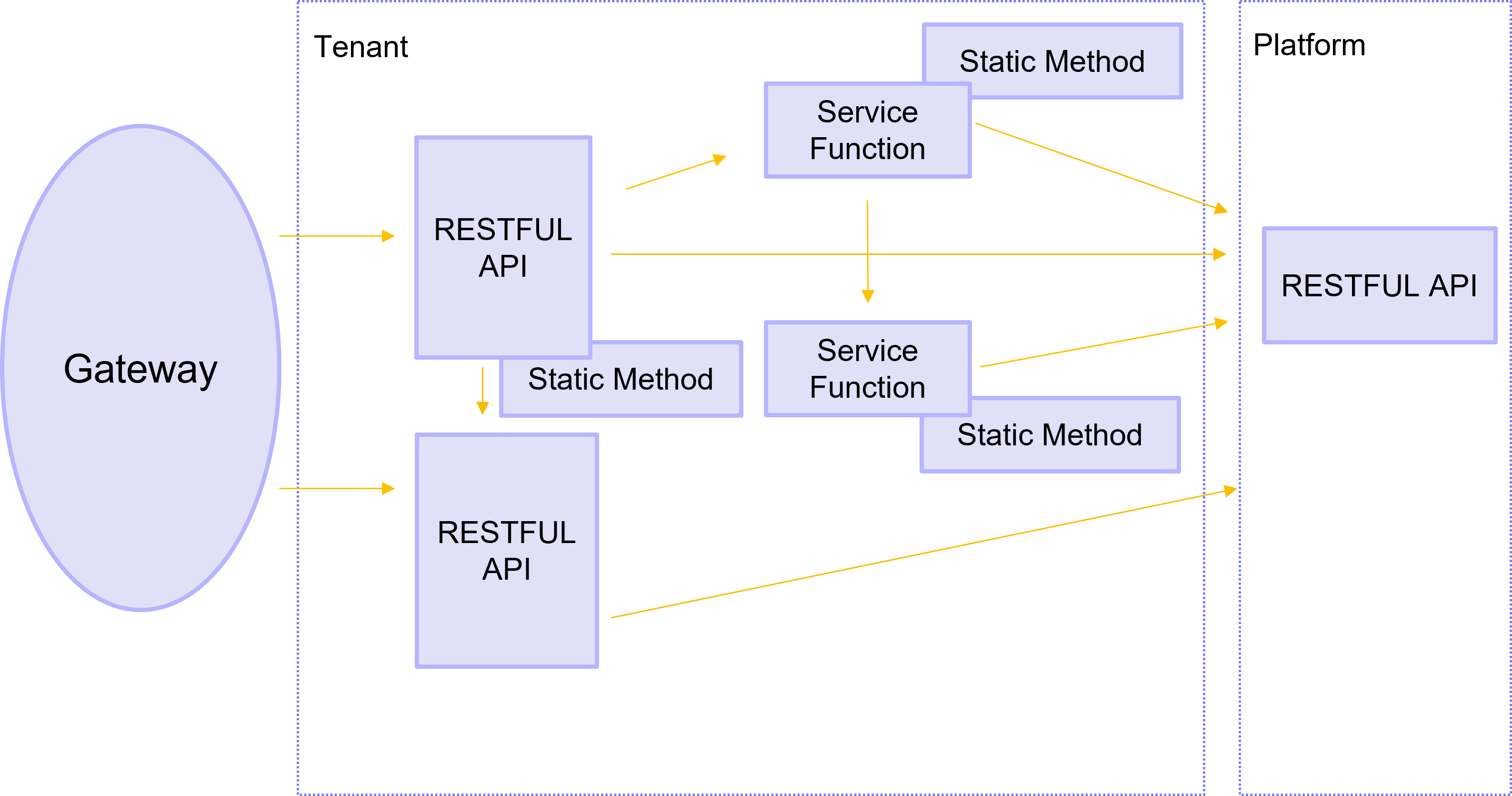
The following diagram illustrates the comprehensive invocation structure for API orchestration configuration. In short, there are multiple invocation paths, each supporting a one-to-many relationship:
- Restful API (Tenant) -> Service Function (Tenant)
- Restful API (Tenant) -> SDK (InsureMO)
- Restful API (Tenant) -> Static Method (InsureMO)
- Service Function (Tenant) -> Service Function (Tenant)
- Service Function (Tenant) -> SDK (InsureMO)
- Service Function (Tenant) -> Static Method (InsureMO)
- Restful API (Tenant) -> Restful API (Tenant)
Technical Principles
{offering}‘s principle is not about making simple individual API calls, but about combining multiple discrete APIs and services into a complete, reusable business application or automation flow.
-
Low-Code Process Abstraction: It abstracts complex integration logic (e.g., call System A, fetch data, transform format, then call System B, branch based on results) into visual flowcharts. This makes building complex applications as easy as drawing a flowchart, reducing technical barrier and accelerating delivery.
-
Declarative Execution: Developers/business users only need to “declare” what the process should accomplish, without needing to program how to do each step in detail. The orchestration engine handles execution details like transaction compensation, error retries, parallel processing, etc., ensuring robustness and consistency.
-
API as an Asset: Every complete process created through orchestration is exposed as a new, higher-level composite API for consumption by other systems or front-end applications. This means orchestrate once, reuse everywhere, rapidly building up the enterprise’s digital capability center.